San Cono
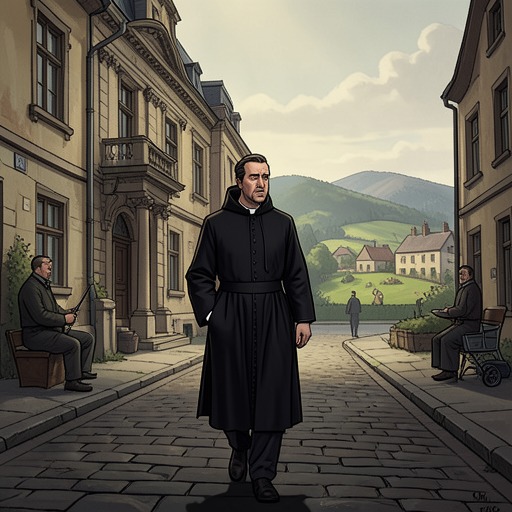
The LeopardSan Cono is Father Pirrone’s birthplace and family home, a small rural community whose relative isolation gives his visits a sense of return to an earlier, more intimate world. In February 1861, he comes back for the fifteenth anniversary of his father’s death. The village setting connects his life in the Jesuit Order and at Villa Salina with the family, property, and local customs from which he came.
Setting and Distance from Palermo
The narrative presents San Cono as a tiny hamlet in the valley rising from Palermo, but stresses that its relationship to the city has changed over time. In the later period described, the autobus has drawn it into Palermo’s orbit; a century earlier, it belonged to a separate local world, four or five hours by cart from the city. Father Pirrone’s journey in 1861 still takes five hours in a cart, making the return a substantial passage rather than a brief visit.
The valley combines coastal lushness with the harsher character of the interior. Sudden winds are a defining feature of the route, strong enough to affect the course of bullets and to send marksmen elsewhere. The journey also brings Father Pirrone into contact with a carter who knew his father and recounts memories of him. The hamlet is thus introduced through both its physical distance and the local relationships that preserve knowledge of earlier generations.
Family Origins and Household
Father Pirrone’s father, Don Gaetano, had worked as an overseer of two properties that the Abbey of Sant’ Eleuterio considered its own in the territory of San Cono. Although the position carried risks, Don Gaetano avoided trouble through discretion and careful conduct. His modest savings gave the family a measure of standing in the hamlet’s depressed economy. They included a few almond trees at the valley’s end, rows of vines on the slopes, stony pasture farther uphill, and a small house at the entrance to the village, on the road to Palermo.
The house was a compact, square building, blue outside and white within, with four rooms downstairs and four upstairs. Father Pirrone left it at sixteen, after success at the parish school and the Abbot of Sant’ Eleuterio’s support opened the way to the archiepiscopal seminary. He returned every few years, including to bless a sister’s marriage, so San Cono remained connected to his religious vocation as well as to his family life.
On this visit he comes for the anniversary of Don Gaetano’s death, on a clear, windy day corresponding to the day of the death fifteen years earlier. His mother, sisters, and nephews welcome him. The house’s interior and arrangements have not changed: the same brick floor, sparse furniture, narrow windows, and familiar family routines mark continuity across the years of his absence. A dog, Romeo, recalls the earlier family dog that had accompanied Father Pirrone in childhood. The meal of macaroni, prepared with the household’s customary ingredients, belongs to the same domestic continuity.
Religious and Community Life
The family proceeds to the church for a commemorative Mass and then to Don Gaetano’s tombstone in a side chapel. The women kiss the marble and grieve, while Father Pirrone leads the prayer in Latin. The sequence places family mourning within the village’s shared religious practice, with the priest’s public role joined to his private identity as a son.
Father Pirrone has become a local figure of distinction. Women, children, and young people gather around him to ask for his blessing or recall earlier times. His return briefly brings together the life he left behind and the authority he acquired beyond San Cono. Yet the visit is not presented as a complete withdrawal from change: one nephew, Carmelo, wears a tricolour cockade, a visible sign of political enthusiasm that Father Pirrone regards with disapproval. The new national symbols have reached the household, even as its setting and routines retain their older shape.
Narrative Significance
San Cono supplies the personal history behind Father Pirrone’s otherwise familiar presence among the Salinas. The hamlet’s household economy is modest but stable enough to give Don Gaetano local standing; his son’s education then carries him from that village home toward the seminary and a different social world. The return makes that transition legible without severing it: family obligations, the anniversary Mass, and familiar domestic customs continue to draw the priest back.
The village also frames a further family episode. After the visit, Father Pirrone is confronted at home by his sister Sarina’s distress, and the family’s concerns require him to seek a dispensation for a niece’s engagement to her cousin. He leaves for Palermo two days later. San Cono therefore functions not simply as a point on his early biography but as the place where religious office meets the complications of kinship. Its later connection to Palermo contrasts with the five-hour cart journey of 1861, while the household’s persistence gives the place its lasting significance in his story.